Thursday, May 31, 2018

Making Decisions Part 2

When I sat down to write about making decisions last time I really wanted to write this post, but I felt like I had to start with the foundation that every game should have some underlying goals. With that fundamental assumption out of the way, I'm excited to write about what I really wanted to talk about: Everything.

Everything that happens, should happen for a reason. Every decision can be used to say something, to make your players feel something, to encourage them to do something. Part of why I love roleplaying games so much is that everything is completely mailable, and can happen anyway people want it to. These games are no more than a shared hallucination, a reality built upon conversations and understandings, the archetypal social construction. By changing how the stories we create are told, by adjusting the rules and tone of the systems we use, we can adjust the stories in whatever way we want. With this in mind we can look at everything about our games and ask how we should change them to better suit our goals. Now I'm going to talk about some of the things I think I have learned by looking at game design through this lens, and maybe some of my words can help you.


The first thing I learned was that its easy to just use the rules which are already in the book. The less questions you are forced to ask about the basic and not so basic assumptions which a system makes the less work you have to do. Its much easier to assume that all the decisions which the system's designer made are the right ones for you and to just take them, but this isn't always the case. HP in D&D assumes you want heroes who can take risks and get hit without permanent consequences, the skill system in WoD assumes that each skill and stat will be equally useful in your game, and Champions assumes that you are a robot who derives pleasure from balancing your hero's checkbook and meticulously simulating 12 second of combat over the course of 8 hours. For many groups and games these assumptions may be correct, but its worth taking the time to stop and think if the game which is presented in the rules is really what you want to play. For me personally, the answer "because thats what the book says" is never a sufficient reason to keep a rule the way it is.

That being said, its also easy to not realize the value in a group's continuity of rules. For the most part, everyone will assume that things are the way they were before or how they have always been, and changing these assumptions can come as a shock. If people have been playing with the same understanding of elves in their games for decades then suddenly changing them will come as a surprise which may work against your goals for the game. It may be worth it to not change rules because the shift itself would be too difficult and take away from what one is really trying to convey in their game. A game about political intrigue is not the right situation to introduce new duel wielding rules, even if they are way better than the old ones. In the same vein, changing something can be used as a tool to create confusion, alienation, or surprise, regardless of what the change actually is. Violations of continuity can be used to break up monotony or show something which couldn't be shown without a explicit change.


In the long run, however, I think my most important realization is that it is easy to make decisions for the wrong reasons. This is the main reason why I believe knowing what you want to achieve with your design is so important. Once you have guiding principles you can look at every decision and have a metric to judge what the right and wrong answers are. There is nothing better or worse about playing a game which is fun because of its evocative storytelling or engaging mechanics, but the decisions which need to be made for each of them are drastically different.

For me, the only thing more frustrating than finding a flaw in a design is finding a flaw which I have been making over and over again. Right now that flaw is failing to have solid goals and failing to make decisions which match up with those goals. In the recent Donjon game at THE CABIN, I failed to identify that one of my goals was to have fun by providing a sandbox where people could come up with their own interesting and wacky solutions to the problems presented. Because I didn't realize this I made decisions which failed to allow a diversity of solutions. In my Colors game I didn't think about how my desire for unique, special, and long lasting characters clashed with the DCC mortality system which ended up causing a really unsatisfying encounter the first time someone went to 0 HP. I'm sure that I will make some mistake along these lines again in my upcoming Hell game, but hopefully by explicitly thinking about and laying out these ideas I can avoid some of my mistakes, and help others to do the same.

Monday, May 28, 2018

Making Decisions Part 1

I feel that its really easy for me to loose the forest for the trees when making decisions about roleplaying games. Looking at my past, the questions I though were important were not, what I spent time focusing on was not worth spending time on, and so the decisions I made were wrong. And I don't mean I was subjectively wrong; I mean as objectively wrong as is humanly possible in this beautiful, inscrutable universe of ours.

I don't know what this is but I think it looks pretty.


The reason I am able to say this with such confidence is that I had no set of metrics by which to measure or reason about my decisions. When I was working on my games, constructing narratives, crafting characters, planning encounters, I never had a goal which I was striving to achieve with these decisions. With no goal, my decisions couldn't be correct because I had nothing to measure them by. I had no idea if I was making progress and achieving what I desired or not. For this reason, I think the most important thing to do when writing a game is to come up with the core set of goals which you hope to achieve through the game.

I don't want it to seem like I'm arguing for something totally grandiose and out there when I say this. These goals don't have to be lofty and pretentious like "create world peace," "critique late-stage capitalism," or "convey the experience of smearing vanilla ice cream over your naked body"; 99% of the time the main goal is going to be just "Have Fun," and that's ok. The important thing is that this fun is approached in a consistent and meaningful way to make sure that it is actually reached. In addition, getting a little more specific will probably help in achieving this fun. Do you want this fun to come from telling a funny story and having the players join in? What about from the pure power fantasy of pretending to be awesome and doing awesome things? Maybe the fun is in having a believable system and rewarding players for solving difficult situations using the tools available to them. All of these are valid decisions which would probably lead to fun, yet they all would play totally differently.

I think that once one decides what it is exactly they want to convey and explore in their games, they can then find the best way to do that infinitely better than if they had never specified their goals in the first place. Now that I've written a bit about the importance of setting goals, I next want to write about some pitfalls I have run into in making my games in the past and how I hope to avoid them again.

Saturday, May 26, 2018

Rank 1 Genius Spells

The following are the current draft of the 1st level spells which I created for my wizard stand in for the Hell Game, the Genius. My thoughts here are to create spells which are powerful, versatile, and interesting. I also tried to not over define things and constrain the spells' uses and instead provide wiggle room for player and DM.

I think all of these provide diverse and interesting options for play except for Wizard Legs and Wizard Eyes. Wizard Legs is only used in two ways (casting on self or an ally), but provides interesting actions which the Genius and others can take and reinforces the whole coward idea, so I'm ok with it. Wizard Eyes seems to bring into question whether a self referential reality (as Alex likes to put it) would even have hidden signs which to interpret. I already am planning on not really having multiple languages. I think I'm going to leave it in for now as a "hint" spell, which can let me tell the player things which they may have missed or may not put together on their own, though that implies that I shouldn't be giving hints otherwise. Hmmm...

As always I would love feed back, and specifically if these spells sound fun and inspire interesting and cool actions.

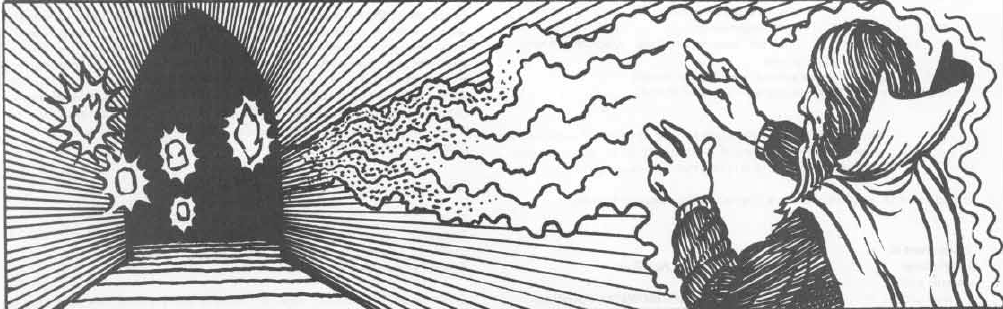
Wizard Orbs from the AD&D PH


Rank 1 Genius Spells:


Read the Signs/Wizard Eyes

This spell allows the caster to read the nature of phenomenon normally too ephemeral or esoteric to easily observe. This includes being able to comprehend magical runes, learn adjectives of artifacts, or understand effects of powerful abilities.


Present/Wizard Grab

This spell allows the Genius to magically cause an object which is visible within 10 feet of them to appear in their hand. If there are complications (intervening objects, partial view, tightly held/fastened objects, ect.) then the spell has a chance to fail. This spell can also be cast in reverse to instead magically place an object in the Genius' hand somewhere within 10 feet with the same restrictions.


Stick/Wizard Glue

This spell causes the Genius to be able to create a thick, gooey substance which hardens after a round into an all but unbreakable adhesive. This glue can be made for 1 round/lvl of the Genius after casting.


Grease/Wizard Grease

This spell allows the Genius to spread a slippery and flammable oil like substance over an area or object. Handling greased objects or walking on greased surfaces is incredibly difficult, and requires regular checks to avoid failure. Each casting provides enough grease to cover about an 100 sq. ft. area plus 10 sq. ft. /lvl of the Genius.


Fog/Wizard Mist

This spell allows the Genius to create a thick soupy mist which lowers visibility to about 10 feet and hampers the effects of fires. The Genius can make 100,000 cub. ft. plus another 10,000 cub. ft./lvl, and the fog lasts about an hour.


Escape/Wizard Legs

This spell give the Genius' target powerful locomotion abilities allowing them to run and jump about twice as fast or far as normal. This effect lasts about 1 hour/lvl of the Genius.


Dancing Lights/Wizard Orbs

This spells creates a few flying glowy orbs which the Genius can control. These orbs can fly at a rapid pace anywhere the Genius can see, can provide reasonable illumination, and last as long as the Genius is able to concentrate on them.

A Long Awaited Return

Hello my numerous and avid readers, I'm happy to announce that my hiatus has ended and I am now here to post nonsense once again. In addition to working on my programming project, I am hoping to get back on the ball on writing rpg nonsense again, and will hopefully be posting the relevant ideas here as I work through them.

In addition, for this, my "summer of freedom," I will be trying to post updates on how well I am keeping up with the goals I have set for myself. I'm not sure yet if I want to post these daily or weekly, but I suspect in addition to obvious and boring posts regarding whatever nonsense I come up with, there will be nonsense posts about whatever obvious and boring things I have been doing or failing to do over the course of the week.

I have some ideas that I'm sure will be arriving here shortly, so look forward to more rambles in the coming days.

Monday, February 22, 2016

Skills in Hell

This has been sitting half done for like a week now, so I'm just going to fucking finish it. Its ramble-y and probably won't be good but I need to do it and move on.

As you all have probably figured out by now, I like talking about and fiddling with mechanics. Mechanics as metaphor, mechanics guiding good roleplay, and mechanically clever systems are all things that I enjoy thinking about and feel pretty confident talking about. As a DM or player, I also see the value in many things that are not mechanically based, but I feel much less comfortable giving advice or talking about those things. How am I supposed to give advice on describing rooms when I'm looking for that advice myself?

Because of my relationship with mechanics of a game being responsible for my outlook and understanding of those games, I generally look at skills as a tool to change how a character interacts with the game world.

At its most basic, monster lore allows your character to try to decipher the clues before or during your encounter to learn about your foe and better understand what you are up against. This is boring when you learn things you already know, but is awesome when that information allows you and your party to change how the encounter occurs in a interesting and meaningful way.

This is the sort of interesting interaction that I would like to have in my game.

During Alex's princess game, I played Bhaltair Blueheart, the King's Knight. I don't remember exactly how the proficiencies broke down, but I was a master of sword and shield combat. Each round I could choose whether I wanted to block with my shield, bash a person with it, or use it to protect someone else. I approached each round of combat differently knowing I that I had the choice of going all out or defending an ally if it was strategically important.

That is the sort of interesting combat dynamic change that I hope to have in my game.

In my uncle's game, there is a weapon proficiency called shield use which gives a +2 bonus to AC and saves when wielding a shield. This changes the numbers of fighters, allowing them to have lower AC, but doesn't really add anything new or change how the class is played.

This is the sort of thing I'd like to avoid.

So like I talked about last post, I'm planning on having the skill system be on a five point scale. Here I'm going to outline the ideas of each rank and also give an example in the form of monster lore.

If you have one box in a skill, its pretty analogous to a non-weapon proficiency: You are now able to make checks in a non-combat situation which will provide a benefit. These are pretty by the book.
Gerry's skill in monster lore allows him to look at tracks, scat, and the environment of a monster in order to get an Int check at -4 to figure out what it is and its powers are. If he can go off of a description of the monster, he can make the check at par. If Gerry can see the monster and is facing it down himself, then he gets a +4 on the check (not that it will do him much good).

When you get up to two boxes checked, the skill now changes how you approach combat. You now have an active check you can make during combat.

Gerald has learned quite a bit from studying his manuals and now can apply his skill. Once per combat encounter (am I really implementing per combat uses on skills?) when making an attack he may make an intelligence based check. If he succeeds, Gerald has managed to apply his theory to give himself a +4 to hit, +4 to damage, or make the monster make a save or suffer a reasonable debilitation. (stab the dragons spit gland with a spear so if it fails its save it has to take an action before breathing fire)

With three boxes checked you now receive a small numerical buff and a passive ability. This is as far as reasonable normal universed characters usually get. Past this is mostly only possible for immortal characters (like those in Hell) or in bullshit over the top campaigns (like one where you journey to the bottom of Hell and beat up the Devil).

Geraldo is now considered a master Lore-er of monsters. His understanding of types of attacks and abilities monster's possess grants him a +2 (1?) on all saves vs monsters he has successfully identified. In addition, whenever any "natural" attack or abilities is used, (not granted by a class) Geraldo can ask the DM to make an int check to get the (meta) stats on the attack/ability.

Past this I don't even know what to do. Obviously additional bonuses are in order for levels 4 and 5, and I suspect with the nature of the world of Hell being they will be more rediculous and over the top than reasonable and normal. I'm thinking level 4 gives noncombat bonuses again, and level 5 gives in combat bonuses. Maybe a stat increase. I'm really not sure.

Progression with skills will be completely separate from levels. Because of how individualized these all are I'm also changing each character to have 1 rank 2, 1 rank 1, and one rank 1 of choice.

As you can tell, this whole idea is much more of a mess than I though it was when I sat down to write about it. I'm going to publish it because when I don't publish things I stop writing, and I don't want to do that.

Monday, February 15, 2016

Five Boxes

AD&D is beautiful in its obscure archaic rules and presentation of said rules. Each class has its own experience track which twists and turns relative to others, growing and shrinking at confusing times, sometimes ending, sometimes stretching off forever. The same can be said for saving throw charts and thaco, the patterns they follow never being quite the same, but always telling a story. Watching a Fighter go from being the worst at resisting effects to being able to stand up to Dragon Breath is an exhilarating journey, as is seeing everyone succumb to evil death magic except for the Cleric of the sky daddy. I personally enjoy gazing at the charts and noticing interesting little anomalies and relationships that form and each tell a story. That being said, its pretty shitty design.

Shots Fired
The giant picks up his boulder and hurls it at Freddy the Fighter and ... Does that hit? Wait I think that I'm out of range of a Frost Giant, but not a Stone Giant. Let me look up their thaco, how many hit dice are they? Did I fail that save vs spell? Give me a min to double check my saves for this level, they might have changed.

Holy shit, way to fucking ruin the moment.

Complicated systems are beautiful to look at and think about, but pretty terrible to actually play. Its why Champions can take the amazing prospect of pretending you're a super hero and transform it into a boring night of wasting time double checking what the DCV adjustment due to speed is for traveling 20 meters per second. Its also why no one in their right mind uses weapon speed or to hit adjustments based on weapon vs AC.
This is someones attempt to make the table make more sense.
DCC brings up a brilliant point when it talks about xp, and that is that there are essentially two types of xp systems: Fiddly systems and not so fiddly systems. AD&D has a super fiddly system, tracking each individual monster killed and gold piece earned to add to an ever growing integer which you may or may not add 10% to and then compare to a table of large numbers. For my Hell game I'm going to use a very unfiddly system. Every time you complete something major, difficult, and time consuming, you get an experience point. Once you get 5 (five), you level up. I even have a bar to make it easy to keep track of.

This is the system I intend to use for pretty much any system involving advancement or keeping track of numbers from 1 to 5. Skills/proficiencies have ranks from 1 to 5 that can be leveled up. Your renound for your unique Body, Mind, and Mouth all rank from 1 to 5, along with people's astonishment at your ever increasing trove of treasures. Your secrets will progress from being incredibly useful to worthless as you tell more and more people, again represented by boxes that are filled in. (this time three)
Its really hard to draw consistently sized boxes.
This system will hopefully make keeping track of your progression simple and clean. It will also hopefully tap into the animalistic part of your brain that likes coloring boxes and filling them up, slowly addicting my players to playing my game, after which I will add micro-transactions and pay-to-win elements so I can eat la vics for the rest of my life. 

Saturday, February 13, 2016

Dudes of Hell: The Sympathetic Villain

This is the classic evil villain trope. Is some sort of specialty wizard, summoner or necromancer.

You always had a plan. Cheating, conning, or just stealing, you could always get what you wanted. This made it a simple matter for you to abuse your way into a position of power. You acquired pawns and power from places others were afraid to even think of. Soon your true colors where shown to the world. Your name became feared and hated, people wept when they learned of you approach, and with good reason. But even you were not without a heart. A single good deed you performed for another. That was all it took for your enemies to be upon you and everything you worked so hard to create to crumble. Your first act of kindness was also your last.
  • Where are you from?
  • Who/What were your servants/powers and what did you do with them?
  • What was your one good act?
  • How did you die?

Your past is behind you, your future in Hell is ahead.
  • What is your goal? Why do you seek the 9th layer?
  • What is your motto?

Your ability to create foolproof plans is your greatest strength and your greatest flaw, you alone are able to make plans for any situation, even in Hell.

  • What is your master plan?
Like the bard, this last question is meant to make the player get in the mind of the character and try to develop advanced long term goals. Its one thing to say, "I want to be the Lord of the Nine Hells," but quite another to say, "My master plan is to trek to the Ninth Layer of Hell where I will challenge Asmodeus to a game of chess. Little does he know that I will have been practicing playing chess throughout my journey with anyone who is willing to play with me. From all this careful study across the planes, I will discover/invent another secret move analogous to castling/en passant which I will debut on the Lord of the Ninth. In addition, I will get my hands on any and all mind altering substances so I'm juicing for the game."

The Villain's power is their ability to make master plans. This is not automated, the player still must come up with amazing ridiculous plans, but they will have some help. The secret to making plans work in Hell is not to plan for everything, because that would be impossible. No, it is instead to acquire as many McGuffins as possible so that when something that you didn't plan for comes up you can rely on them to bail you out. Every time you make a plan and tell it to the DM, they will give you a hint for each McGuffin you own. In addition, once per plane per McGuffin, As the Villain, you start with one McGuffin: your incredible intellect and ability to create plans. If the player ever forgets to write that he forgot to bring rope, obviously the character would have remembered. (at the cost of his once per plane McGuffin stuff) This can be recharged by the Villain having a chance to relax and recharge his mind and doing some puzzle/other frivolous intellectual exercise. Other examples include: membership to the Esteemed Diabolical Gentleman's Society, a Bag of Tricks, or a mouthy familiar.

Wizardy stats, high int, high wis, low strength.

Tentative Summoner starting spell list:
1.) Summoning I, Farspeaking, Conjure Item, Detect Summons, Read Magic
2.) Summoning II, Protective Circle, Call

Skills:
People Use: * *
Stone Cold: * *
Lambasting? Alertness? Knitting? *